


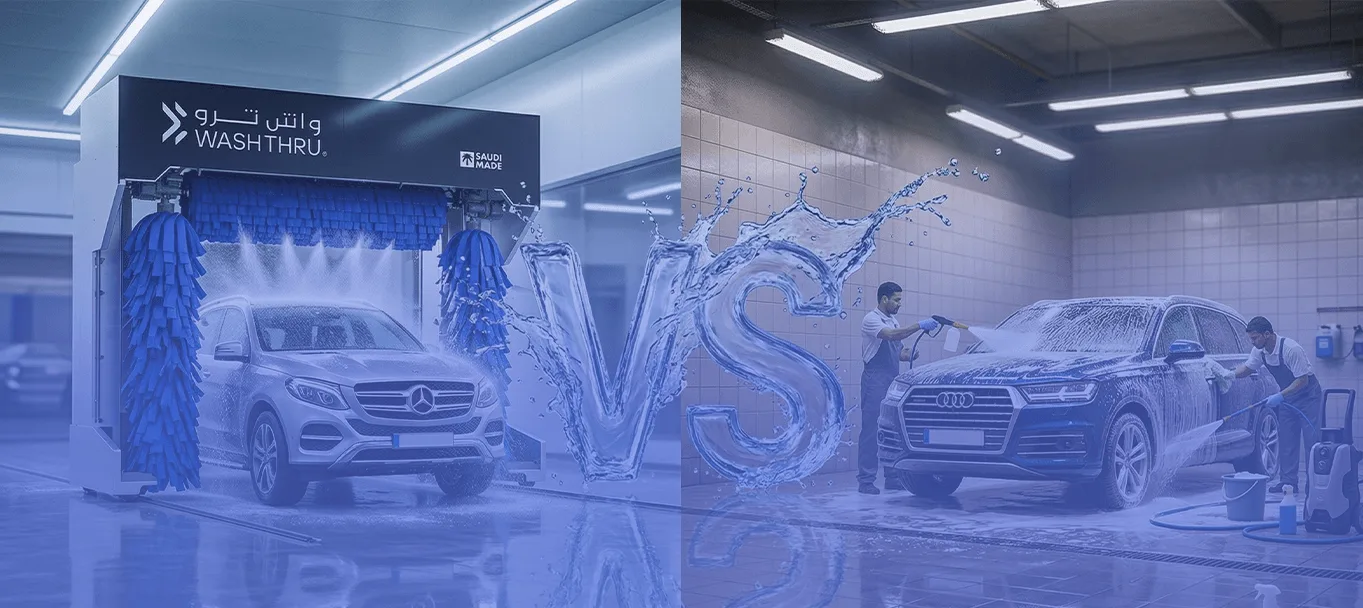
Automatic vs. Manual Car Wash: Key Differences, Pros and Cons
The car wash industry has seen major changes in recent years, especially with the rise of automatic car wash technology that has transformed how these businesses operate. While manual car washes are still common in many cities, automatic car washes have been gaining ground thanks to their speed and operational efficiency.
Choosing the right type of car wash depends on several factors, including the size of the investment, service speed, the number of cars targeted per day, and the ability to manage staff. That's why many investors look for a clear understanding of the real differences between the two systems before deciding to launch their project.
In this article, we break down the differences between manual and automatic car washes from every operational and investment angle.
What Is a Manual Car Wash?
To understand the real differences between car wash types, it helps to first look at how a manual car wash works and how it's typically run. Here's a brief overview.
How Does a Manual Car Wash Work?
A manual car wash relies mainly on human labor to clean the vehicle. Workers use water hoses, sponges, and specialized detergents to remove dirt from the car's exterior, then dry it by hand.
The washing process usually involves several steps: rinsing with water, applying soap, hand scrubbing, then rinsing and drying. The quality of the result depends largely on the worker's skill and experience.
Where Are Manual Car Washes Usually Found?
Manual car washes are common in residential neighborhoods and small commercial areas, since they can operate in a limited space with a relatively low setup cost compared to automatic systems. They're also frequently found at fuel stations or near parking lots, as they rely more on labor than on specialized equipment.
What Is an Automatic Car Wash?
As car wash technology has advanced, automatic systems have emerged that can complete the wash process quickly and with consistent quality. Here's a simple explanation of how this type of car wash works.
How Does an Automatic Car Wash Work?
An automatic car wash relies on specialized equipment that carries out every stage of the wash mechanically. The car moves through a sequence of stages that include rinsing, applying detergents, cleaning the body with brushes or high-pressure jets, then rinsing and drying.
The entire process is controlled by an electronic system that precisely manages the distribution of water and detergents, helping deliver consistent, repeatable results for every car that enters the wash.
Types of Automatic Car Washes
There are several types of automatic wash systems used in the industry. Each system differs in how it operates and how many cars it can handle.
The most common types include:
- Rollover car wash: the car stays parked in place while the wash arms move around it to complete the cleaning stages. This system suits small spaces and fuel stations that don't have room for a long wash tunnel.
- Tunnel car wash: the car moves on a conveyor through a wash tunnel that includes several consecutive stages such as rinsing, cleaning, rinsing again, and drying. This system can wash a large number of cars per hour, making it suitable for high-traffic locations.
- Touchless (brushless) car wash: this system relies on high-pressure water and chemical detergents to remove dirt without using brushes. Some customers prefer this option because it reduces the risk of scratching the car's paint.
To learn more about the differences between these three types of car washes, see our article: the difference between automatic car wash systems.
The Difference Between Automatic and Manual Car Washes
Once you understand how each system works, it becomes easier to compare their operational performance. Here are the key differences that matter most to investors and business owners.
1. Service Speed and Car Volume
A manual car wash typically takes between 15 and 30 minutes per car, which means daily capacity stays relatively limited. An automatic car wash, on the other hand, can wash a large number of cars in a short time — some systems can wash dozens of cars per hour — which increases the business's daily revenue.
2. Reliance on Labor
Manual car washes rely heavily on labor, meaning ongoing costs for salaries, management, and supervision. Service quality can also vary from one worker to another. Automatic car washes, by contrast, need far less labor since most of the process is handled by machines, which reduces operating costs over the long run.
3. Water Consumption
Manual car washes often use large amounts of water because there's no precise system controlling usage during the wash. Modern automatic car washes use advanced control systems and water recycling, which helps reduce consumption and improve the project's environmental efficiency.
Disadvantages of Manual Car Washes
Despite being widespread and easy to set up, manual car washes face a number of operational challenges that can affect a business's profitability and stability. Here are the most notable ones.
1. Heavy Reliance on Labor
Manual car washes need a large number of workers to operate, which raises salary and management costs. If even one worker is absent, it can directly affect service speed and quality. This can be reduced by switching to automatic wash systems, which need less labor and boost operational efficiency.
2. Lower Capacity
The number of cars a manual car wash can handle per day is limited, since each car takes a relatively long time to finish washing. Automatic car washes, in contrast, allow more cars to be served per hour, increasing revenue and investment efficiency.
3. Inconsistent Service Quality
Wash quality at a manual car wash largely depends on the worker's skill and experience, so results can vary from one car to the next. Automatic systems deliver a consistent level of quality since every wash stage follows a set program unaffected by human factors.
Advantages of Automatic Car Washes
Automatic car washes have become a popular choice for investors thanks to their ability to achieve higher operational efficiency compared to traditional car washes. Here are the key advantages these systems offer.
1. High Washing Speed
Automatic car washes can wash a large number of cars in a short amount of time, increasing the wash's capacity and reducing customer wait time. This plays an important role in boosting daily revenue, especially in locations with heavy car traffic such as fuel stations or highways.
2. Reduced Reliance on Labor
Automatic equipment carries out most of the wash stages without significant human involvement, reducing the need for a large workforce. This helps lower operating costs and improves the long-term stability of running the business.
3. Consistent Wash Quality
Automatic car washes run on set programs that precisely control each wash stage, such as water and detergent distribution and cleaning time. This ensures a consistent quality level for every car that enters the wash. Manual car wash quality, by comparison, can vary from worker to worker, while automatic systems deliver a uniform experience for customers every time.
4. Lower Water Consumption
Many modern automatic car washes use smart systems to control the amount of water used during washing, and water recycling systems can also be integrated into the wash. This helps reduce water consumption compared to manual car washes, which can waste large amounts of water during the wash process.
5. Higher Wash Capacity
Automatic systems allow more cars to be washed per hour compared to manual car washes, raising the business's operating capacity. The more cars that can be served per day, the greater the chance of achieving higher revenue, especially in locations with steady car traffic.
6. The Option to Offer Monthly Subscriptions
Automatic car washes make it possible to offer customers monthly subscription packages, letting a customer wash their car multiple times for a fixed fee. This model helps generate steady income for the business and increases customer loyalty.
7. Easier Project Management and Operation
Automatic car washes rely on programmed operating systems that reduce the need for constant labor supervision.
This makes it easier to manage the business and reduces issues related to staff management or inconsistent service quality.
Disadvantages of Automatic Car Washes
Despite the significant advantages these systems offer, there are a few challenges to keep in mind when investing in this field. Here are the most important points, along with the available solutions.
1. Possible Scratching With Old or Poor-Quality Systems
Some older systems, or those from unreliable manufacturers, can cause scratches, especially if the brushes aren't maintained and cleaned regularly. This can be avoided by choosing modern systems such as a touchless (brushless) automatic car wash equipped with sensors and advanced technology, like the ones WashThru offers.
2. Limited Access to Some Fine Details
Automated arms may not reach every corner with the same precision as a human hand, especially in tight spots or when cleaning the car's interior. This can be addressed by combining an automatic exterior wash with a manual interior clean at the same facility to get the best possible result.
3. Higher Initial Investment Cost
Setting up an automatic car wash requires a larger initial investment compared to a small manual car wash that relies on simple equipment. However, the return on investment is typically higher over the medium and long term, thanks to the higher number of cars served and the reduced reliance on labor.
Advantages of Manual Car Washes
Despite the challenges they face, manual car washes are still a good fit for certain small businesses or limited locations. Here are the main advantages of this model.
1. Low Setup Cost
A manual car wash can be set up at a relatively lower cost compared to an automatic one, since it doesn't require purchasing specialized equipment or complex operating systems. This makes it a suitable option for small businesses or anyone looking to start with limited capital.
2. The Option to Offer Additional Cleaning Services
Manual car washes allow for a variety of services alongside the exterior wash, such as interior detailing, tire polishing, and cleaning the upholstery or dashboard. These add-on services can increase the revenue per car and give customers more options to care for their vehicles according to their needs.
Related Articles
A Detailed Feasibility Study for an Automatic Car Wash Business
Requirements for Opening an Automatic Car Wash and Obtaining Licenses
Which System Is a Better Investment?
After reviewing the advantages and disadvantages of each type of car wash, it becomes possible to assess which option makes more sense from an investment standpoint. Here's a brief breakdown of the factors that influence the decision.
1. Profitability
A car wash's profitability depends largely on the number of cars it can serve each day. The higher the wash's capacity, the higher its potential revenue.
That's why large-scale investment projects tend to favor automatic car washes, which allow more cars to be served throughout the day.
2. Operating Costs
Manual car washes rely on a larger number of workers, meaning ongoing costs for salaries, management, and supervision. These costs can also rise over time due to the need to replace or train staff.
Automatic car washes, on the other hand, have relatively lower operating costs since most of the wash process is handled by machines, reducing reliance on labor and making the business easier to manage.
3. Ability to Scale and Grow
Manual car washes are often limited in the number of cars they can serve per day, which means growing revenue depends on adding more staff and space.
Automatic car washes, however, make it much easier to increase operating capacity, and the business can be expanded further by adding monthly subscriptions or opening new branches based on the same operating model.
How Does WashThru Help You Set Up an Automatic Car Wash?
WashThru provides complete automatic car wash systems suited to different types of businesses and spaces, including:
- Rollover car wash, available in several models: suited to small spaces and fuel stations, with different models such as the Rollover RS-V4, the Rollover RH-V1, and the Rollover RA-V1
- Tunnel automatic car wash: which can serve a large number of cars per hour and suits high-traffic locations.
- Touchless (brushless) car wash: which relies on water pressure and detergents without touching the car's body, available in RCV-V1 models and the RF-V1 model
Setting up a successful automatic car wash doesn't just depend on buying the equipment — it requires careful engineering and operational planning from the very start. Here are the key services WashThru provides to support investors in this field.
Complete Solutions to Maximize the Project's Return on Investment:
- Site layout planning: a comprehensive plan is prepared showing equipment placement and car flow to ensure the best use of space and maximize the wash's capacity.
- Engineering placement of equipment: equipment locations are precisely determined to ensure operational efficiency and smooth car movement within the facility.
- Supervision of site construction work: specialized teams oversee construction and technical preparation work to ensure the site is ready before the equipment is installed.
- Staff training on operation and maintenance: the operating team is trained on how to run the equipment and perform the regular maintenance needed to maintain operating efficiency.
- Suitable accounting solutions: including revenue and subscription management systems that help organize the business's financial operations.
- Multilingual technical support: technical support services are provided to help operators quickly resolve any technical issue.
- Routine and emergency maintenance services: regular maintenance helps preserve equipment efficiency and reduce unexpected breakdowns.
- Equipment upgrades and refurbishment: providing solutions to update and upgrade systems in line with advances in car wash technology.
Availability of Automatic Car Washes in Saudi Arabia and Libya
WashThru's role isn't limited to supplying automatic car wash equipment — it also includes supporting investors across several markets to make it easier to set up this type of business. Here's the geographic scope of our services.
1. Automatic Car Washes in Saudi Arabia
WashThru supplies automatic car wash systems within the Kingdom of Saudi Arabia through its headquarters in Jeddah, making it easier for investors to obtain the equipment, technical services, and support needed to set up their project. Having a base within the Kingdom also helps provide consulting and technical supervision throughout the planning, installation, and operation stages.
2. Coverage of the Libyan Market Through Suppliers and Distributors
WashThru also supplies automatic car wash systems in Libya through a network of local suppliers and distributors, helping facilitate equipment supply and technical support for projects within the Libyan market. This presence helps serve investors looking to set up automatic car washes in various Libyan cities.
Frequently Asked Questions
Do you have other questions about automatic or manual car washes? Here are some frequently asked questions that might help:
1. What's the difference between a manual and an automatic car wash?
The main difference lies in the washing method: a manual car wash relies on human labor, while an automatic car wash uses specialized equipment to carry out every wash stage mechanically.
2. Do automatic car washes damage the car's paint?
Modern systems are designed to be safe for the car's paint, especially systems that use soft brush technology along with regular maintenance.
3. How many cars can an automatic car wash clean per hour?
It depends on the type of system used, but some automatic car washes can wash dozens of cars in a single hour.
4. Is an automatic car wash business profitable?
The business can be profitable when the right location is chosen and efficient wash systems are used that allow a large number of cars to be served daily.
5. How long does washing a car take at a WashThru automatic car wash?
Wash time varies depending on the type of system used. At a WashThru rollover car wash, washing a car takes an average of about 3.5 minutes per car. At a WashThru tunnel car wash, it can take about 1.5 minutes per car thanks to the continuous movement of cars through the tunnel. By comparison, washing a car at a manual car wash usually takes 15 to 30 minutes on average.
6. Where are manual car washes usually found?
Manual car washes are common in residential neighborhoods and small commercial areas, and sometimes at fuel stations and parking lots, due to their low setup cost and heavy reliance on labor.
Conclusion
After comparing manual and automatic car washes from various angles, it's clear that each system has its own advantages and use cases. Manual car washes may be a good fit for small businesses or locations with limited traffic.
But for investment projects targeting a large number of cars per day, automatic car washes offer higher operational efficiency and the potential for a better return on investment in the long run.
Related Articles
The Halt on Manual Car Washes in Saudi Arabia: What's the Best Alternative?
Learn why manual car washes are being phased out in Saudi Arabia and the best ways to switch to a more profitable, efficient, and sustainable automatic car wash.
Touchless Car Wash: A Profitable Investment That Attracts Higher-Value Customers
An investor's guide to opening a touchless car wash: how to increase revenue, target higher-value customers, and build a profitable car wash business with modern technology.
Automated Car Wash Business Feasibility Study: A Complete 2026 Guide
A feasibility study for an automated car wash business covering costs, profits, risks, and smart wash systems from WashThru, to help you make a well-informed investment decision.
