


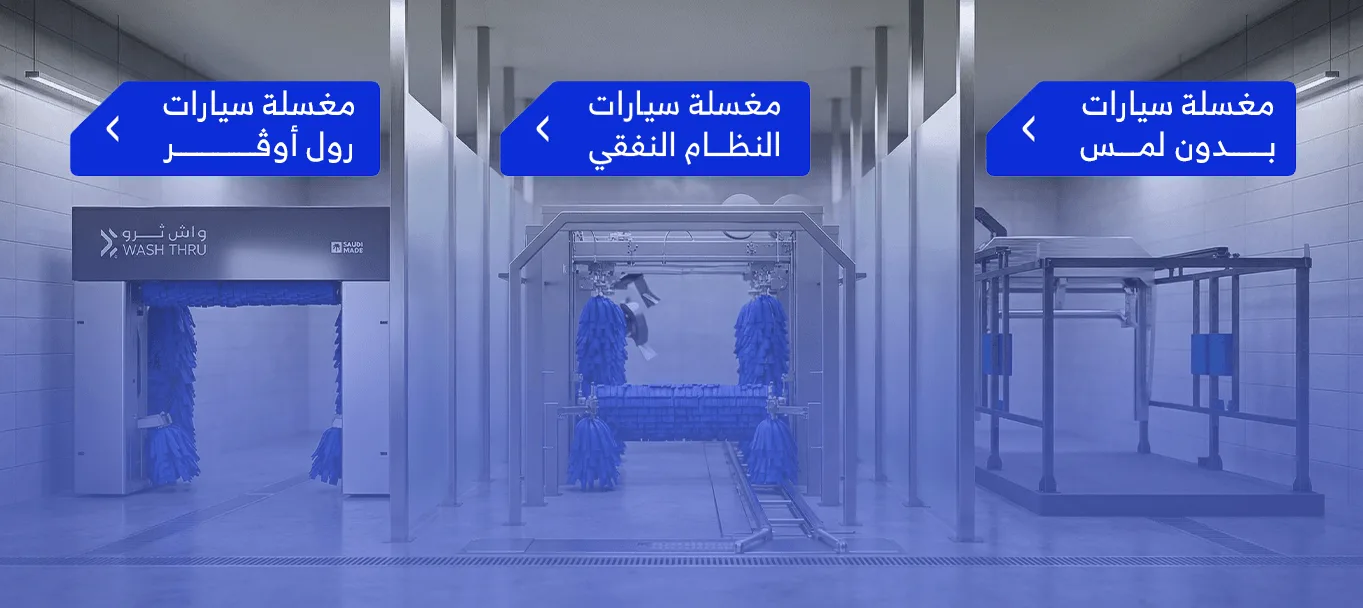
Automatic Car Wash Systems Compared: Rollover vs. Tunnel vs. Touchless — How to Choose
When researching the difference between a rollover car wash and a tunnel wash, or comparing a touchless automatic car wash to traditional systems, investors often find only general information that doesn't explain the operational and economic differences in depth.
In reality, the differences between types of automatic car wash systems go beyond shape or the way the car moves. They come down to:
- The mechanical design philosophy
- The dirt-removal mechanism
- The cost of an automatic car wash (both setup and operating costs)
- Throughput capacity
- The nature of the target customer base
- The climate (especially in Saudi Arabia's desert environment)
- Future scalability
Understanding these factors is the foundation for choosing the best type of automatic car wash in Saudi Arabia or Libya for your location. Beyond selecting the type of machine, a project's success doesn't depend on the equipment alone — it also depends on the site's engineering design, the financial feasibility study, and the operation and maintenance plan.
That's why WashThru's role isn't limited to supplying rollover, tunnel, or touchless car wash systems. It also includes:
- Engineering site design for the wash
- Preparing a car wash project feasibility study
- Supervising installation
- Training the operating staff
- Ongoing maintenance and technical support
- Equipment upgrades and refurbishment
These elements directly affect a project's sustainability and profitability, especially in highly competitive markets such as Saudi Arabia.
First: The Rollover Car Wash
How does a rollover car wash system work mechanically?
In this system, the car remains completely stationary inside the wash bay, while the wash unit itself moves along side rails. The moving unit passes through several sequential stages:
- An initial rinse to remove surface dust
- Application of foam or cleaning agents
- Operation of the side and top brushes
- A final rinse
- Air drying
The core philosophy here is: stationary vehicle – moving machine. This design reduces complexity compared with a tunnel system, since it doesn't require a long conveyor or a continuous drive system.
WashThru offers 3 different rollover models: Rollover model RS-V4, Rollover model RH-V1, and Rollover model RA-V1.
Advantages of a rollover car wash (detailed analysis)
1) Lower setup cost — why, exactly?
The lower cost isn't just a matter of a "smaller footprint" — it comes down to clear engineering factors:
- No need for a long building or a tunnel dozens of meters long
- No need to install a complex conveyor system
- Fewer pumps and motors
- Drying systems are more limited compared with a tunnel car wash
All of this reduces the required investment capital (CAPEX). For an investor, this means the financial break-even point arrives sooner, which reduces risk in the first year of operation.
2) Suited to smaller spaces
Since the car doesn't travel through a long path, the system needs relatively less space. It can be installed at:
- Existing fuel stations
- Plots of land with limited area
- Residential neighborhoods with high rents
A smaller footprint means lower land or rental costs — a factor that directly affects project feasibility.
3) Mechanically simpler operation
The absence of a conveyor reduces:
- Mechanical friction points
- The likelihood of cars drifting out of position
- Failures related to drive chains
That said, the brushes do need regular maintenance, especially in sandy environments, since accumulated particles can affect performance and wash quality.
Drawbacks of the rollover system
1) Limited throughput
Each cycle typically takes 4 to 8 minutes, and a new car cannot enter until the current cycle finishes completely. This limits capacity during peak hours.
At a location with heavy car traffic, this can lead to long queues, which may push customers to look for a faster alternative.
2) Brush sensitivity to quality and maintenance
Scratches aren't caused by the brushes themselves, but rather by:
- Sand accumulating within the bristles
- Use of low-quality materials
- Neglected routine maintenance
That's why the quality of the system and how it's operated are both critical.
If your site is in a residential neighborhood or a fuel station with limited space, a rollover car wash machine from WashThru may be the ideal solution for balancing cost and return. Contact our experts to have your site analyzed in detail before making a decision.
Second: The Tunnel Car Wash
How does the tunnel system work from an engineering standpoint?
In tunnel car wash machines, the vehicle enters a path fitted with a conveyor. The car moves gradually through several fixed stages:
- Initial rinse
- Foam
- Multiple brush units
- High-pressure rinse
- Protective wax
- Powerful drying
The philosophy here: moving vehicle – multiple fixed units working in parallel.
Why does the tunnel system have the highest throughput?
Because a new car can enter roughly every 20–30 seconds, with different stages working simultaneously on multiple cars inside the tunnel at once.
This means:
- More cars washed per hour
- Fixed costs spread across a larger volume of operations
- An improved profit margin per operating hour
Advantages of the tunnel system (expanded analysis)
1) High throughput capacity
At locations with heavy traffic density, a tunnel system can serve dozens of cars per hour without a full stop between cycles. This makes it well suited to main roads and major commercial areas.
2) An advanced customer experience
The ability to add multiple stages (polishing, wax, protection) raises the perceived value of the service and allows for premium pricing on advanced packages.
Drawbacks of the tunnel system
1) High setup cost
The reasons:
- Constructing a long building
- Installing a complex mechanical conveyor system
- Multiple pumps and electrical systems
- Powerful drying systems with high energy consumption
This raises the capital required, making the project less suitable for an investor with a limited budget.
2) Maintenance complexity
A conveyor breakdown can stop the entire line. The system also needs a regular maintenance team to keep operations running efficiently.
If your site is on a busy highway in Saudi Arabia or serves heavy commercial traffic, a tunnel automatic car wash from WashThru may deliver the highest operating return. Contact us to analyze the expected car flow at your location.
Third: The Touchless Automatic Car Wash
The technical philosophy of a touchless system
This system relies on:
- High water pressure (High PSI)
- Alkaline and acidic chemical agents
- Dissolving dirt before removing it
There are no brushes or direct mechanical contact with the car's body.
Why doesn't it cause scratches?
Micro swirls — fine circular scratches in the paint — usually occur when a hard object rubs against sand particles trapped on the surface. In brush-based systems, if the brushes aren't maintained properly, they can pick up abrasive particles that leave circular marks on the paint.
In a touchless car wash system:
- There's no mechanical contact
- Dirt is removed through chemical breakdown and water pressure
- No bristles or solid materials touch the paint
For the owner of a new or dark-colored car, this is a sensitive point, since micro swirls show up clearly under light. That's why "no contact" is a powerful psychological and marketing advantage.
Why might it be less effective on heavy dirt?
Thick, muddy dirt bonds to the surface mechanically. Pressure alone may not be enough to remove it completely without mechanical assistance (brushes).
This can lead to:
- The need for stronger chemicals
- Higher consumption of cleaning agents
- Higher operating costs over the long run
The marketing appeal of a touchless system
The phrase "touchless" is associated in customers' minds with:
- Paint protection
- Modern technology
- Safety for luxury vehicles
This often allows the service to be priced higher than traditional systems, especially in markets with high customer awareness.
If you're targeting the luxury car market in Saudi Arabia or looking for a premium service in Libya, a touchless car wash from WashThru could give you a clear competitive edge. Consult our experts to determine the technical specifications best suited to your site.
A Comprehensive Comparison of the Three Systems
Below is a comprehensive comparison of the three types of automatic car wash systems in terms of investment capital, operating expenses, and throughput:
1. Investment capital
- Rollover car wash: The lowest cost, thanks to simpler structures.
- Tunnel car wash: The highest cost, due to more complex infrastructure.
- Touchless car wash: Mid-range cost, depending on pressure and pump specifications.
2. Operating expenses
- Rollover car wash: Moderate electricity and water consumption.
- Tunnel car wash: Higher consumption due to the number of stages and powerful drying.
- Touchless car wash: Higher chemical consumption to compensate for the lack of friction.
3. Throughput
- Rollover car wash: Suited to medium-traffic locations.
- Tunnel car wash: Best suited for heavy traffic.
- Touchless car wash: Relatively lower throughput.
A single, standard price can't be set without a site study. For an accurate estimate, it's best to contact a WashThru expert to determine pricing based on your project's specifications.
For more financial details on returns and the break-even point, see our article: Feasibility Study for an Automatic Car Wash Project, prepared by the WashThru team, which analyzes operating and capital costs in depth.
Which System Is Right for Your Project?
The final decision doesn't depend solely on which system is technically best — it depends on traffic density, your target customer segment, and your available investment ceiling, as follows:
- If your budget is limited and your site is small: a rollover car wash is a logical choice.
- If your site is on a highway or in a busy commercial area: a tunnel car wash delivers a higher return.
- If you're targeting luxury cars or customers focused on paint protection: a touchless car wash may be more suitable.
Related articles
Steps to Open an Automatic Car Wash Project — Licensing Requirements 2026
What Are the Stages of Automatic Car Wash Operation? A Detailed Guide for Investors
What's the Difference Between Automatic Car Washes in Saudi Arabia and Libya?
The Saudi market
- High traffic density in major cities
- A desert environment that requires precise brush maintenance or high-pressure calibration
- High competitiveness that demands excellence in quality or speed
- The importance of water-recycling systems
The Libyan market
- Infrastructure that varies from one city to another
- The importance of having local technical support available
- Shipping and installation costs to take into account
WashThru provides services directly inside Saudi Arabia, and authorized distributors are available in Libya to provide local support and after-sales services.
WashThru's Services for Automatic Car Wash Projects
WashThru's role isn't limited to supplying automatic car wash systems — it extends to providing a complete package that starts with the initial concept and continues through to the project's actual operation.
Our services include engineering site design for car washes that ensures efficient traffic flow and space use, preparing an accurate financial and operational feasibility study, supervising civil works and system installation, training operating teams, and providing ongoing maintenance programs and technical support.
We also offer equipment upgrade and refurbishment solutions to raise efficiency and improve performance. We operate directly in the Saudi market, with authorized distributors available in Libya to provide local support and after-sales services.
Frequently Asked Questions About Automatic Car Washes
Still have questions? No problem — we've gathered the most common questions below for anything on your mind:
1. What's the difference between a rollover and a tunnel car wash in terms of profitability?
Profitability depends on daily car volume.
- At medium-traffic locations, rollover may be more efficient due to its lower cost.
- At high-traffic locations, a tunnel system achieves greater profitability thanks to its high throughput.
2. Is a touchless car wash effective in a desert climate?
It can be effective, but heavy sand may require higher pressure or specialized chemicals.
3. What factors determine the cost of an automatic car wash in Saudi Arabia or Libya?
Cost varies depending on:
- The type of system (rollover, tunnel, or touchless)
- The required production capacity
- The size of the land
- Infrastructure works
- Water treatment systems
- Shipping and installation costs
- Availability of local technical support
For an accurate estimate, it's best to contact the WashThru team to study the site and determine the appropriate specifications.
4. Which automatic car wash system is best in Saudi Arabia?
In Saudi Arabia, the choice depends on the geographic location:
- Major cities and highways: a tunnel system is often more suitable due to high traffic volume.
- Residential neighborhoods and fuel stations: rollover achieves a good balance.
- Upscale areas: a touchless car wash may be a suitable choice, given customers' focus on paint protection.
The desert environment also requires a good routine maintenance program for brushes, or precise calibration in high-pressure systems.
5. Is a touchless car wash effective at removing dirt in a desert climate?
A touchless car wash system relies on pressure and chemicals, and can be effective on ordinary dirt. However, in heavily sandy environments, accumulated sand may require additional mechanical assistance. That's why it's important to choose suitable pressure specifications and precisely calibrate chemical ratios.
6. Can a rollover car wash be upgraded to a tunnel system later?
In practice, a full conversion is rarely straightforward, since a tunnel system requires different infrastructure and a larger footprint. It's best to decide on the right system from the start, based on a study of expected traffic.
7. Which system consumes more water and electricity?
- A tunnel car wash consumes more electricity due to the number of stages and drying systems.
- A touchless car wash may consume more chemicals.
- A rollover car wash is usually in the middle in terms of consumption.
Using water-recycling systems can significantly reduce operating costs across all systems.
8. Does WashThru provide services in Saudi Arabia and Libya?
WashThru provides engineering design, feasibility studies, installation supervision, maintenance, and technical support services within the Saudi market. Authorized distributors are also available in Libya to provide local support and after-sales services.
If you're planning to set up an automatic car wash in Saudi Arabia or Libya, the WashThru team provides a feasibility study, engineering design, implementation supervision, and technical support and maintenance to ensure stable, long-term operation. Contact us to determine the right system for your project based on precise engineering and financial analysis.
Related Articles
Touchless Car Wash: A Profitable Investment That Attracts Higher-Value Customers
An investor's guide to opening a touchless car wash: how to increase revenue, target higher-value customers, and build a profitable car wash business with modern technology.
RF-V1 Touchless Automatic Car Wash Machine
Discover the RF-V1 touchless automatic car wash machine, delivering fast performance and smart technology with low water consumption and maximum operating efficiency.
RCV-V1 Touchless Automatic Car Wash Machine
Discover the RCV-V1 touchless automatic car wash machine, featuring an advanced exterior structure and greater vehicle capacity, high performance, and smart operating technology.
